Wednesday, 20 May 2015

Seth and Maureen's African Road Trip


I was lucky enough to have my boyfriend Seth come and visit me for two weeks! We started in Botswana, stayed in Namibia for a few days and then headed to Victoria Falls. Then we crossed back into Botswana at the other side of the delta and looped back around to Maun where he flew out of. He was able to spend a few days in my village and even shadowed me at work. Here are some of the highlights in pictures: 


Morning rainbows. If you go during a full moon there are moonbows. Pretty incredible!

Rain jackets were a must, and we got soaked anyways

The water went over the falls at such high velocities and then shot back up into the air, causing a perpetual rain storm despite the sunshine. You can see the contrast between spray from the falls here along the bridge you have to cross. 

A rock hyrax, the closest living relative of the elephant if you would believe it

Lilac-breasted roller, one of the most common birds in this country.


We saw so much wildlife on our trip through Chobe National Park near Kasane, Botswana. This is a pensive impala

Seth's first elephant! (not in a zoo) We pulled over to watch him for a bit

Botswana has the most elephants out of any other country in the world....we saw hundreds over the course of a couple days.

(Sorry for the rotation issue) This is a fish eagle, the Bald Eagle's close African cousin


Hippos everywhere in Chobe!


This croc is regulating his temperature by sunning with his mouth open like this


This is a family of kudu, a beautiful species of antelope.


A family of elephants crossing to higher ground by the Chobe River just outside of Kasane where we were staying. 


Sorry again about the orientation issue! Thirsty giraffe


We found ourselves in the middle of a pride of about 11 lions during the last few minutes of the last game drive we did. We stopped the car and watched them as they passed us before following them for a bit. There were two or three large females with their offspring.


A young lion.

It was neat to listen to them "talk" to each other with little growls and gutteral noises. 


Next we headed for the salt pans in the eastern part of Botswana. During the time of year we were visiting, they were filled with water. The entrance area to the pans is actually a bird sanctuary that the local village created as a community cooperative project. There were some beautiful birds residing in and around the pans. We even saw some flamingos fly by!

Wildebeest! Lots of them in the pans 


This pan, called the "Soa" pan, is the second largest in the world. But when combined with the neighboring networks of pans, it forms a body of water even larger, making it the biggest in the world.

The salt pans looked like one big lake, but they were shallow enough to walk across if you wanted to. 


Botswana is in the middle of a multi-year drought, so it felt strange to stand on the shores of what looked like a lake, knowing that the water is far too salty to be potable. 


The trouble with "rata" (love)

Botswana is an impressive country. It is home to the world’s largest inland delta, it has unmatched wildlife in its national parks (more elephants than any other country on the planet), and it has one of the least corrupt governments in Africa. But things aren’t entirely rosy in this country, even though people try to pretend they are.

You see, Botswana is challenged by the roots of HIV, which run deep and pervade farther than you could even imagine. Even in Setswana, for example, the word for “love” and “like” are one and the same. There’s not even a distinction between the two on paper.  And that’s just the start of it.

Of its modest 2 million citizens, about 2/3 of the women claim to have experienced some form of gender-based violence in their lifetimes. That means over 65% of women have been abused, whether it be physically, emotionally, financially, etc. And that’s only reported cases.  And after Swaziland (a little nugget situated inside of South Africa, Botswana has the highest rates of HIV in the world. In fact, Botswana actually graduated from the Peace Corps in the 90s but was later asked back because of the unbelievable losses from HIV. Even today, around 50% of middle-aged women are HIV positive. Those numbers, frankly, are astounding.

Without knowing anything about this place, it’s easy to sit there and scratch your head asking how Botswana got in so far over its head with the HIV epidemic.  With only 2 million people and a national wealth built on a foundation of diamonds, how could this all have happened?  Now, I’ve only been here for a few months, but I’ve learned a lot and I think I can shed some light (keep in mind these are just my own insights)….

1.       Botswana is grappling with the clashing of traditional and modern values. A huge majority of the population here is Christian. And I don’t mean the kind that only goes to church on holidays. I mean speaking in tongues, channeling the holy ghost, multiple-days-of-the-week churchgoers. But, this doesn’t seem to reflect in a lot of their culture. Why is that? I’m getting there, don’t worry.

2.       Marriage…in Botswana, who needs it? I’ve noticed that, especially in the north where I am living, there are hardly any weddings or marriages. This seems like it’s mostly because of the price. A husband-to-be has to pay a lebola, or dowry, for his wife. This varies in price, but can be any number of cattle plus cold hard Pula on top of that. Interestingly, this practice is deep-rooted in tradition, but has evolved into something of a competition. It’s something you can brag to your friends about (“Well my husband paid 20 head of cattle for me…..yours only paid 12?). And, on top of the show-offy nature of it all, it leaves the family of the groom broke and unable to support the newlyweds, who are traditionally expected to move in with the groom’s family straight away. Wouldn’t this money be better spent on a new house or plot of land for the newlyweds? The uncles are the ones who negotiate all of this and also receive a “commission” from the lebola negotiation. And let’s face it, nothing good ever comes of a greedy uncle. Plus, once a woman is married, she doesn’t get much out of the union itself. The marriage is a formality which the man is often essentially expected to disregard even from before it is made official. That leads me to my next point…

3.       Culture of infidelity. Men here (and often women, not to discriminate) are incredibly unfaithful. It doesn’t matter if you are married or dating or what…there is pretty much no expectation that a couple will stay faithful to each other. On multiple occasions I have had conversations explaining how this whole concept of infidelity is foreign to me as an American. I mean sure, people in America are known to cheat, but rarely is it brushed off and seen as normal or even expected. Not that it is encouraged here. People will tell you that you shouldn’t do it, but when it comes down to it, cheating is a part of a relationship. There is even a term for a man’s mistress, or “small house,” referring to the small house built on his compound for her to live in, right under the wife’s nose. And child defilement is something that can be found in every village/town in this country. Transactional relationships between older men and young girls exist where the men give the girls cell phones, air time, new clothes, etc. in exchange for sex. When you're a teenage girl who has no income for yourself, it's easy to see how tempting such relationships can be. Not to mention the myths that exist whereby if you have sex with a virgin you will be cured of HIV. Turns out that's not true, but it doesn't stop men from trying it anyways. 

4.       The end of the month is my least favorite time in Botswana. At the end of the month, everyone gets paid their monthly salary. The bars are full, people are staggering around, and the verbal abuse is rampant. I know what parts of my village to avoid (the bar that the chief owns, for example, despite a big sign posted near the community center that shows him taking a stance against alcohol), but it’s impossible not to notice the drinking culture here. In fact it was one of the first things I picked up on. At the risk of generalizing, it seems that for the most part people either drink to get wasted, or else they are staunchly opposed to alcohol consumption. There is little to no middle ground where people have a couple beers in a social setting, which makes it hard to explain your own preference for alcohol. It’s such a hot-button issue when people ask you, and you never know which side of the chasm they are on. Alcohol is involved in a staggering number of instances of gender-based violence and HIV transmission. It has accelerated the progression of this virus unfathomably, as HIV transmission in cases of sexual abuse is incredibly higher. The government has even tried to discourage alcohol usage by charging a high alcohol levy tax, but it seems as if it has had no effect on consumption rates. So instead, people are spending a higher percentage of their income on purchasing the same amount of alcohol, leaving them with fewer funds to, for example, support their family with. I’m not disagreeing with the existence of the alcohol levy, just questioning if it’s the most effective way to tackle these issues.

5.       And to me, this is really the kicker: the government employs a majority of people in this country and has the power to send its employees anywhere in the country with no real say from them. Here, government workers include all clinic/hospital employees, teachers, miners, builders, cleaning staffs, and even some clothing stores. If you want to talk about big government, you should do some research on Botswana. With a lot of families where the husband is the breadwinner, he may be sent to another part of the country to work, while his wife and children are left in the home village. He might come home for holidays, but it can get lonely living somewhere by yourself…this seems to be where a lot of the sleeping around happens. And when he does return home on the holidays, who knows what kinds of STDs and infectious baggage he is bringing back with him. This is especially true with miners who spend so much time living in groups of men far from home at the mines where sex workers linger and loneliness bites.  I really believe that by breaking up families for employment purposes like this, it is putting undue strain on the family unit and creating voids filled by infidelity and lack of family prioritizing. And the thing is, no one talks about this as being a large contributing factor. For Batswana, it's just the reality. 
  
You see, this this country is small. With only 2 million people living within its borders (and about 150 PCVs), its one small world. And when many of those people have multiple concurrent sexual partners, may not be using protection, and are living far from their families and partners in a culture that on some level accepts this infidelity, you can see how HIV seems to have spread like wildfire. Not to mention the desire among many young people in this country to get the virus early so that you don’t have to keep worrying about getting tested or contracting it later. Test positive now, and don’t worry about continuing to test yourself or use a condom for your own protection later. Seems fairly logical when you put it that way, doesn’t it? Especially when you consider that 100% of health care is offered for free in Botswana, so you can be on ARVs (HIV medications) for the rest of your life at no financial burden to you whatsoever.

So knowing what you know now, how on earth do you convince someone that they should watch out for their health and protect themselves against HIV. To many people here, HIV seems like an inevitability, and one that is, thankfully, no longer a death sentence. Stay tuned, folks. That’s my mission. 


Sunday, 29 March 2015


The past two months or so have been some of the busiest I’ve had thus far here in Botswana, so I apologize for the lack of updates! I was in Gaborone, the capital city, for two weeks of training, then I was in Senegal for two weeks of another training, followed by three days at home before traveling back to the capital for a week of another training. I then travelled to India for a week before FINALLY returning to Shakawe. Being away from my village was incredibly difficult, especially because I wanted to be home and starting to work on projects, but had to attend so many mandatory trainings. I was extremely worn out and over-saturated by the time I took my first vacation in about seven months. Below are some retrospective blog updates about these crazy few weeks away from site.

Malaria is a buzz kill! -- A visit to Senegal


Thies, Senegal 

Following two weeks in Gaborone for our in-service training, I was lucky enough to be one of three Botswana volunteers to travel to Senegal for an in-depth training on malaria interventions. The training was a Peace Corps training, held at the PC Senegal training center. There were volunteers from all over Africa, including Cameroon, Benin, Ghana, Malawi, Uganda, Burkina Faso, The Gambia, as well as PC staff members from countries who currently don’t have volunteers for various reasons (Kenya, Liberia, Guinea).

It was really interesting to hear bits and pieces about other volunteers’ experiences. But at times it was definitely frustrating. More and more I am realizing there is a competitive culture among Peace Corps volunteers to make it known how difficult your own experience is. While we were in Senegal, I noticed this dynamic was extremely present…almost in a passive aggressive way. I witnessed some volunteers putting down the service of others in order to make their own seem more legitimate, maybe because they have to suffer more or handle more hardships on a daily basis. However I also realized early on how ridiculous this is…not having electricity or running water does not make an individual a better Peace Corps volunteer. In fact, I think a good argument could be made for the contrary. Hearing these undermining comments being tossed around while with these other volunteers also made me question individuals’ reasons and intentions as volunteers. Sure, I think it is safe to say we are all hoping to get some sort of personal growth out of our experiences, but it seemed to me that for some people, this was more of a priority than helping their community grow. Regardless, after two weeks of this dynamic and four weeks of being away from site, I was ready to return to Botswana.
 

But aside from this competitive spirit that was exhausting, the training was really fantastic. We were able to Skype with individuals from incredibly important offices in the global fight against malaria such as the CDC, PMI (President’s Malaria Initiative), Johns Hopkins, and more. As you can guess, I was public health geeking out pretty much for the entire two weeks. The training shed a lot of light for me on how PC trainings should and could be conducted, as well as highlighting the ways in which our training in Peace Corps Botswana could be improved (tips which we shared with our own training staff). We also learned a lot about technical tools like survey initiatives, doer/non-doer analysis and logical frameworks—all tools for behavior change that can be applied in so many ways to the work we do in our respective countries.

We also were able to spend a day at a beach while there, which was glorious. It was the Atlantic Ocean, and if I turned my back on the buildings along the beach and just looked out at the water, I swear it could have been Delaware. It brought me so much comfort, more than I was expecting and more than I thought I needed.


I only saw a very small part of Senegal, but I realized how much I love Botswana. It was incredibly frustrating not having any way to communicate with the people there. I don’t speak any French, and obviously know nothing of the local language, so I had to rely on others I was with who could communicate. I found it really debilitating not being able to communicate with people directly, especially when trying to haggle down a price. Senegal also has millions and millions more people living in it than Botswana, and it showed in a lot of ways that was at times overwhelming. Returning to Botswana was relieving. Being away had made me realize, without my knowing, that Botswana has become familiar and comfortable. It has become my home.
 

India--Sugar, Spice, and Everything Chai


 Street food was the best (yep, that's a gigantic pat of butter in the middle)

 We got used to getting around on "tuk-tuks," or glorified motorized tricycles


For the first week in March, I traveled to India with eight other Peace Corps volunteers. After not being allowed to travel for six months, a few volunteers were looking up plane tickets to different places to travel for cheap. They decided on Mumbai, and soon several others decided to go as well. India has long been a place I have wanted to travel to, but never got to until recently. And, let me tell you, I will be going back.


It was an intense week which I won’t give all of the details for here, but I’ll describe some of my favorite moments and parts of the trip:

Crawford Market: There was a huge market inside of an old warehouse building that sold everything from toilet paper to spices to puppies (see picture to the right). It was incredibly crowded, but it didn’t phase me. There was so much to take in at each stall that I could have spent the whole day there. One of my favorite moments was seeing a tour group of white people with headphones paused at one of the stalls as their tour guide led them in an audio tour.


 Temples: During the course of the week, we went to a Hindu temple, a mosque, a Jain temple, and a Buddhist temple. They were each uniquely beautiful. At the Hindu temple, people brought strings of flower heads to the temple (see below), where they were rubbed against holy statues, thereby blessing them. I think people then took those blessed flowers home to their own shrines, but I’m not certain.
 

The mosque was located out in the water ad was only accessible via a long causeway. We went there just after the sun set, and the lighting was beautiful. For a while we just sat on the outer wall and watched the retreating tide. There were also men there playing some kind of devotional music as Muslin families sat around listening.
 

The mosque at the end of a causeway
 

I think the Jain temple was my favorite. It took us a while to find the temple, and we almost gave up. When we arrived, there was a group of about 10 women sitting cross-legged in the middle of the temple singing, playing tambourines, and hitting sticks together. Three of us went in together and observed the goings-on from the outskirts of the adorned main room. We didn’t want to be in the way, but we also wanted to take it all in. After a few minutes, a couple of the women beckoned us over to sit with them. They trusted us with a couple of tambourines, and we did our best to keep the beat as they continued singing. After ten minutes or so, they were finished praying, and we stood up to leave. The woman I was sitting next to motioned for us to wait a moment, as she and another women were fumbling with some Rupees. We figured they were going to ask us for money we didn’t have to spend, so we thanked them and started to leave. One of the women came running down the steps of the temple to catch us, and gave us each a 50 Rupee note (about 1USD). She told us it was a sign of gratitude for coming for coming to visit their temple, and that it was something they do for everyone. It wasn’t meant to be materialistic, just a symbol of inner gratitude. After at first starting to refuse the money, we realized this was a non-negotiable donation which would have been rude to refuse outright or give back. So we took the money and instead decided to pay it forward somehow.

 
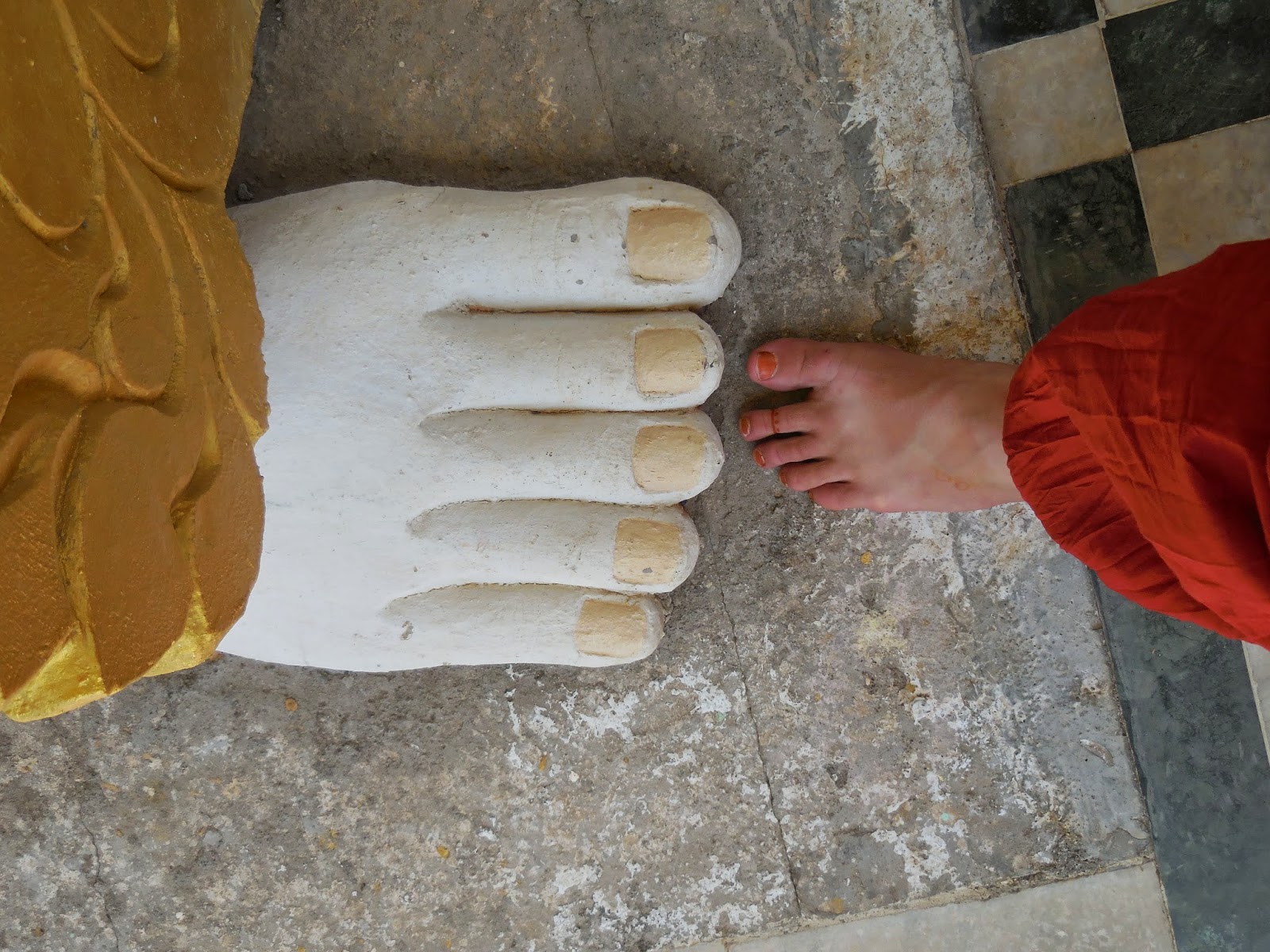
The Buddhist temple (above) was also incredible. It was built only within the last few years, but the enormous gold-domed structure was created entirely with interlocking stones and without any structural supports. It is the biggest of its kind. We were not allowed into the large structure because we have not completed the 10-day Dhama mediation course required to enter. So instead, we were allowed into a smaller adjacent temple where 20-minute long mediation sessions were led for visitors. But we ended up in there with about 100 school kids who were there on a field trip. It was hard to find the peace we were seeking, but was definitely still an experience.


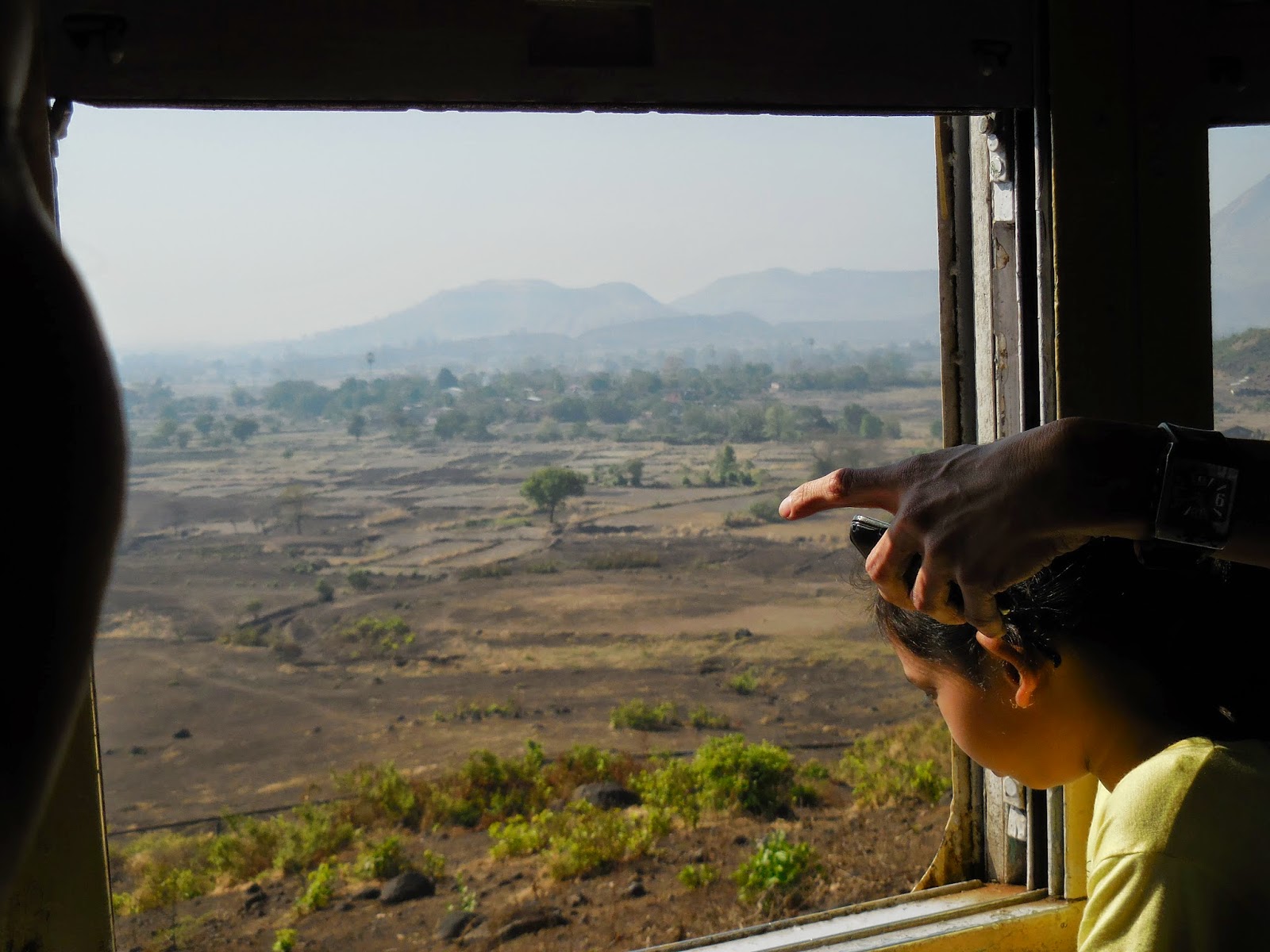
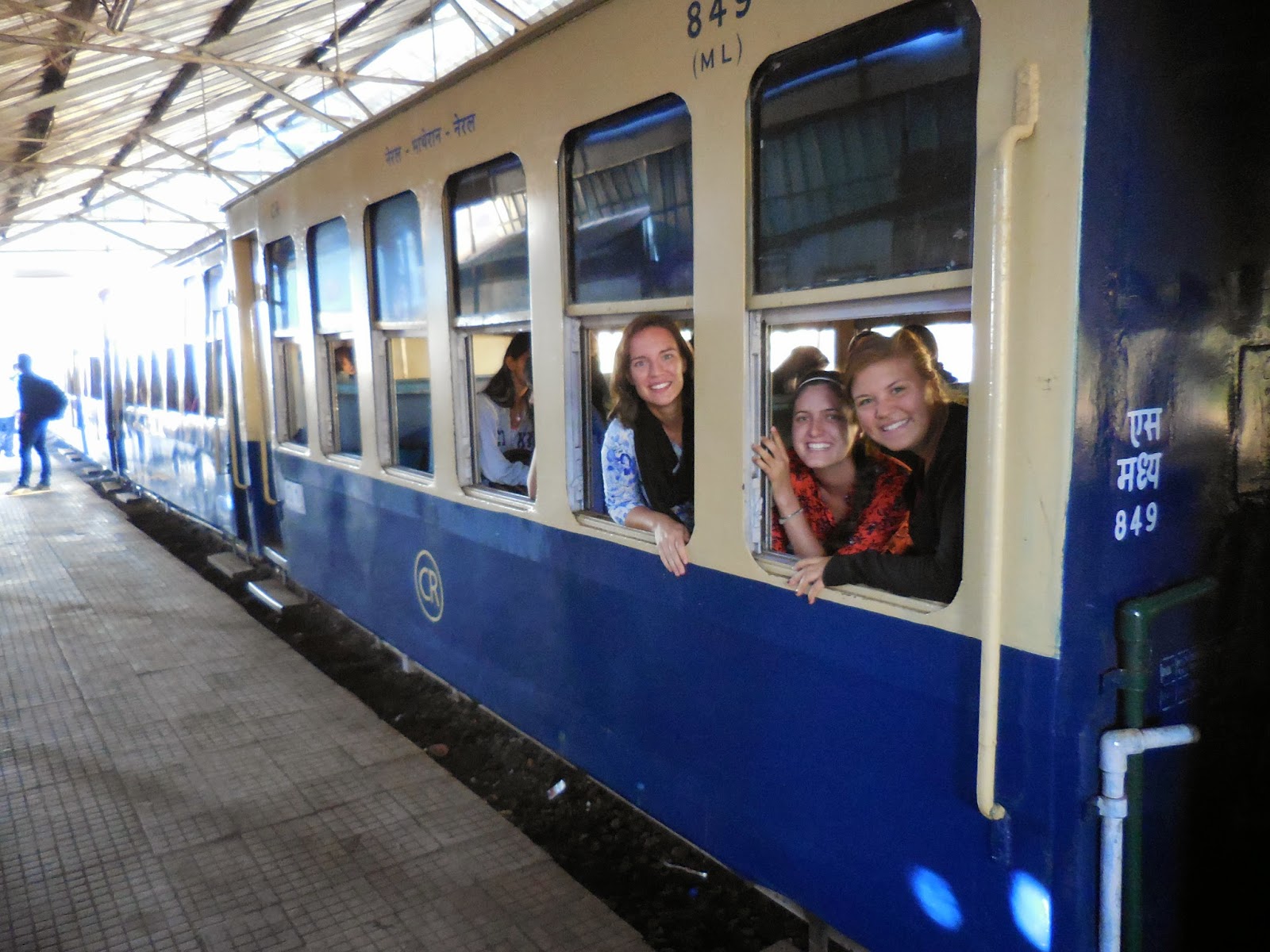
We also visited an island off of the coast of Mumbai with what is known at the Elephanta Caves (see pictures on right)—Hindu caves carved out of the rock face with Hindu deities gracing the walls. In Mumbai there is also Asia’s largest laundromat, which we obviously had to take time to see. It was a pretty incredible operation! We also spent a day outside of Mumbai in a little town called Matheran that has been dubbed a UNESCO World Heritage Site. There are no cars or even bicycles allowed in the town, which is perched on top of the hillside. You can only access it on foot, by horse, or by train. There is a toy train which takes two hours to reach the town from a station on the outskirts of Mumbai. It snakes around the hills next to incredible drop offs that wouldn’t have bothered me if it weren’t for a sign in the train car that warned passengers not to crowd one side of the train because the weight imbalance was extremely dangerous. Even in the dry season when things weren’t green, the views were truly incredible.


 Photos from the trip to Matheran:


I also was able to meet up with my friend Giovanna, who I worked with at Joseph’s House last year. I hadn’t seen her since last May, and spending even three days with her put me so much at ease. There has been a lot going on recently with some of the residents we worked with at the house, and being able to process all of that with her gave me so much peace. Somehow, the time I spent with her and hearing about her own adventures, helped recenter me with the work I am doing back in Botswana—she helped remind me why I decided to do Peace Corps. It’s so easy to get lost in yourself and your life and your loneliness here that it’s not hard to forget your purpose. She helped me to come back to Botswana with new focus, excitement, and meaning for life here. If that’s not a good friend, I don’t know what is. I’ve always said she’s my soul sister, and seeing her in India, of all places, was just what I needed.


 And, of course, we were in India for the annual festival called “Holi.” It started the night before
with huge bonfires in the streets. People built pyres in the streets that were maybe eight or more feet tall out of wood and straw. The next day people throw colored powder at each other in a playful way. Random people would just come up to us with a handful of color and smear it over the side of your face with a resounding “Happy Holi!” There were a couple instances where people came from behind and cracked eggs over other people’s heads. I was lucky enough to avoid it, but about four others in the group I was in weren’t. And, of course, we were targets as a group of eleven white foreigners walking around Mumbai together. At one point, we were ushered into a Holi party at a secondary school where there was music and sprinklers dousing the crowd as well as a bubble machine. We were in there for about ten minutes while the “press” took lots of pictures and videos of the white people dancing around, but then they asked us to leave seeing as it was a members-only party. It was fun while it lasted though! By the end of the day, we were pretty disgusting and exhausted, but it was entirely worth it.


 Somehow, we managed to survive a week in Mumbai with a group of about ten Americans with no robberies, assaults of any kind, theft, etc. It was a week I will never forget, and it ignited something major within me. I don’t know how to describe it other than an appetite. An appetite to see and experience as much as I can. Going to India was pretty impulsive, which is part of why I decided to go. And going there and following through made me realize that I can travel—I can go to all of those places I have seen on maps and on TV, at least in this time in my life.  Travelling there was both invigorating and thrilling.  Some people seek the adrenaline rush from rollercoasters and bungee jumping, but for me, I'm realizing that I seek out cultural experiences. I love to be pushed outside of my comfort zone. I love the feeling of observing a place for the first time, wide-eyed and soaking it all in. For me, there is really nothing quite like it. 


 We visited the largest laundromat in Asia (and forgot to bring our laundry...)


 A couple of friends at the Gateway to India

Cricket players


Malaria is a buzz kill! -- A visit to Senegal


Thies, Senegal 

Following two weeks in Gaborone for our in-service training, I was lucky enough to be one of three Botswana volunteers to travel to Senegal for an in-depth training on malaria interventions. The training was a Peace Corps training, held at the PC Senegal training center. There were volunteers from all over Africa, including Cameroon, Benin, Ghana, Malawi, Uganda, Burkina Faso, The Gambia, as well as PC staff members from countries who currently don’t have volunteers for various reasons (Kenya, Liberia, Guinea).

It was really interesting to hear bits and pieces about other volunteers’ experiences. But at times it was definitely frustrating. More and more I am realizing there is a competitive culture among Peace Corps volunteers to make it known how difficult your own experience is. While we were in Senegal, I noticed this dynamic was extremely present…almost in a passive aggressive way. I witnessed some volunteers putting down the service of others in order to make their own seem more legitimate, maybe because they have to suffer more or handle more hardships on a daily basis. However I also realized early on how ridiculous this is…not having electricity or running water does not make an individual a better Peace Corps volunteer. In fact, I think a good argument could be made for the contrary. Hearing these undermining comments being tossed around while with these other volunteers also made me question individuals’ reasons and intentions as volunteers. Sure, I think it is safe to say we are all hoping to get some sort of personal growth out of our experiences, but it seemed to me that for some people, this was more of a priority than helping their community grow. Regardless, after two weeks of this dynamic and four weeks of being away from site, I was ready to return to Botswana.
 

But aside from this competitive spirit that was exhausting, the training was really fantastic. We were able to Skype with individuals from incredibly important offices in the global fight against malaria such as the CDC, PMI (President’s Malaria Initiative), Johns Hopkins, and more. As you can guess, I was public health geeking out pretty much for the entire two weeks. The training shed a lot of light for me on how PC trainings should and could be conducted, as well as highlighting the ways in which our training in Peace Corps Botswana could be improved (tips which we shared with our own training staff). We also learned a lot about technical tools like survey initiatives, doer/non-doer analysis and logical frameworks—all tools for behavior change that can be applied in so many ways to the work we do in our respective countries.

We also were able to spend a day at a beach while there, which was glorious. It was the Atlantic Ocean, and if I turned my back on the buildings along the beach and just looked out at the water, I swear it could have been Delaware. It brought me so much comfort, more than I was expecting and more than I thought I needed.


I only saw a very small part of Senegal, but I realized how much I love Botswana. It was incredibly frustrating not having any way to communicate with the people there. I don’t speak any French, and obviously know nothing of the local language, so I had to rely on others I was with who could communicate. I found it really debilitating not being able to communicate with people directly, especially when trying to haggle down a price. Senegal also has millions and millions more people living in it than Botswana, and it showed in a lot of ways that was at times overwhelming. Returning to Botswana was relieving. Being away had made me realize, without my knowing, that Botswana has become familiar and comfortable. It has become my home.