Thursday, 8 January 2015

On Loneliness.

So it has been a while since I’ve posted anything. I wish I could say it is because I have been insanely busy with projects and exciting new programs. But that’s just not the case. The truth is I’ve been a slug. A lonely, it’s-too-hot-to-move, lazy slug.  You’d be surprised how impossible it is to do anything when you feel this way. Even though we were allowed to visit fellow volunteers in our shopping village over one of the holidays, it proved harder than expected to be so alone during a time of year where I’m usually surrounded by family. I’ve never missed a Christmas or Thanksgiving with my family, and I really felt that here.

I’m an introverted person with some extroverted tendencies, and I really relish time to myself. I thought that this level of isolation and aloneless would give way to lots of reflection and creative uses of my time. But, honestly, more often than not I pass the time by watching TV shows or movies that I hoarded on my hard drive during training back in Serowe. Because it feels easier to lose myself in some crappy TV show that I would never have watched in the States rather than let myself dwell on my new found loneliness. I have bursts of alternative uses of time though. Like when I spent a Sunday sewing new curtains for my house, or the week when I spent every evening after work digging my garden. But those things sometimes take effort, and just existing here can be truly exhausting.

But I’ve realized that my discomfort with being alone is in direct proportion to the number of hours I spend in my house and by myself, naturally. There are some days when I realize that I haven’t had a real conversation (esp in English) in over 24 hours. And those are the hard days. The difficult part comes when you find yourself in a rut, feeling sorry for isolated self, but knowing that you need to go out and walk around the village. You know it will make you feel better, but if you’re at that point of recognition, it can be incredibly difficult to change out of your unwashed, minimal clothing (who wants to do laundry when it’s so incredibly hot outside….who even wants to move?) and leave the house. But it is always a good decision. Always.


"So what exactly are you doing over there...?" A Typical Day During Community Integration Period

The first three months at site are known as the “community integration period,” or more affectionately called “lock-down” by the PCVs. It means we are bound to stay in our sites and get to know our communities without distractions of traveling and visiting other PCVs. It’s not a time when we are supposed to start any projects or programs. We are just supposed to become orientated to our villages and identify where we can be of the most use. The theory is that if you jump in too fast you won’t make the impact that is most needed or sustainable for your community.

____________________

So a typical day goes something like this (I included extra info to give you an idea of how some things work at the clinic too): 

6:00am: Wake up and do yoga (most days). Sometimes I just get up early to walk down to the river. Enjoy the cool breeze before things heat up too much.

Delta view from one of my morning walks.

6:40am: Eat breakfast, usually outside and with a cup of tea. Get ready for work.

7:12am: Realize the time and rush to get ready. Don’t forget to feed Tsala.

7:15am on-the-dot: Seth calls. Sometimes I tell him to call back if I’m not ready yet… But in theory I leave the house and walk to work around now.

7:30am: In Botswana, working hours start at 7:30 and last until 4:30. The clinic is always incredibly busy in the morning and usually a ghost town by the afternoon. I still haven’t completely figured out why, but I think people just like to avoid the heat. On Mondays and Wednesdays we have report at the clinic, where the staff gets together and debriefs about any updates/issues they have run into.

8:00am-10:30ish am: I help run the Child Welfare Clinic (CWC). Each month, mothers bring their children under the age of 5 in to be weighed. The monthly weights are recorded in a government-issued card so that their growth progress can be monitored. The Health Education Assistant (HEA) and myself also record whether or not the child has been sick in the past month, what their HIV status is, what their feeding method is (i.e. exclusive breast feeding, mixed feeding, etc.), and whether or not their immunizations are up to date. The HEA advises the mothers if anything is off or she instructs them to go and get injections (“mokento”) if necessary. 

Some months are designated as annual supplementation months. That means that all children brought into CWC receive, in Nov and May for example, Vitamin A and Albendazole (the latter is for deworming). Trust me, no kid or adult wants some sort of vaguely foul-tasting, milky substance poured down their throat. Ever. Sometimes the mothers would take turns holding down each others kids, one pinching the nose, another bracing the head and keeping the mouth open while the other holds the body still. And the number of times the child would spit that stuff right out like Old Faithful was more than I could count. Only once was I in the splash zone. I swear these kids are like dogs...their screams inside the CWC would alert the ones outside that something unsavory was coming...thus setting them off in a similar preemptive tantrum. So by the time the next set of kids came in to get their supplements they would already be crying, but they wouldn't even know what for yet. Let me just say Dec. 1 was one of the happiest days of my short CWC life so far. 

In August or so, the some of the clinics in the district started using a computer program where clinic visits are recorded electronically. Everything at the clinic up until this point has been on paper (with multiple carbon copies), so this is a huge change for everyone, especially people who don’t have any computer skills. I have been helping register all of the CWC patients into the system. This means assigning each child a unique ID number which can be used to access information such as immunization records, supplement and other immunization campaigns (i.e. measles campaigns, OPV campaigns, etc.), PMTCT records, HIV status, growth history, illness history, and more. It was a very tedious first 6 weeks or so, but now about 95% of the children who come in have ID numbers. 

10:30-11:00am: Every day we distribute rations to the mothers. They receive a different ration depending on how old their child is. Children aged 6 months-3 years get oil and “Tsabana,” a dry porridge powder made of ground sorghum and soy beans. Children over 3 years up to 6 years get oil, beans, and “Malutu,” a different dry porridge made of a similar but slightly different combination. These government rations are distributed for free and mothers can receive them once a month. Sounds great in theory, but it sounds like the clinic never  has all of these things in stock. Currently, for example, we only have beans. Two months ago there was only oil and Tsabana. The problem isn’t that there are no rations, it’s that they are stored in a warehouse on the other side of the village and there is no transport to move the massive amounts of heavy bags to the clinic (transport issues are probably 65% of why things don’t get done here….or at least the excuse for 65% of why things don’t get done here).

11:00am-12:00pm: Computer lesson for my counterpart. The Health Education Assistant who I work with is trying to get better at the computer. While she gained basic knowledge from lessons with the last PCV that was here, I am helping her master typing. We spend about an hour each day with a typing program that teaches her proper hand placement, speed, accuracy, etc.


12:00pm: Tend to the garden. I helped cultivate a garden in the back of the clinic to grow vegetables for the Home Based Care patients (sort of like for hospice patients, but also for disabled individuals, those with TB and AIDS). I spend some time watering and weeding before lunch.


12:45pm: Lunch. People here seem to either not eat lunch or go home for it. I am lucky enough to live about a 10 minute walk from the clinic, so I go home every day. Lunch lasts until 2:00pm…which I find breaks up the day in a very strange way. I guess they know that Batswana rarely get anything done after lunch, so they make the morning shift extra long. But for someone who has to eat every couple hours, it sure can be a long morning.

2:00ish pm: After lunch what I do can vary. Sometimes I go back to the clinic and spend time there, but generally there is nothing going on. Occasionally I will help count out pills at the dispensary and chat with the nurses. I also use this time to visit with different community members and organizations, such as school guidance counselors, the village social worker, NGOs, etc. I usually introduce myself and find out a bit about what their role in the community is and then spend some time brainstorming how I could partner with them potentially in the future.

3:00pm: Most days at this time I go to a home based care patient’s house to teach her basic computer skills. She is in her late 20s and wheel-chair bound, but has a burning desire to learn computer skills. The hope is that she could use those skills to get a job, start a business, or do something more. Her days currently are empty and filled with a lot of idle time. It has been a bit of a slow process and we had to start completely from scratch, but she is starting to pick it up. It’s especially hard because she has no way to practice when I’m not there. It’s like trying to learn an instrument but only getting to play when your teacher comes for a lesson. And to add on to that she is a self-described slow learner. But we are taking it slow and doing what we can.

4:30pm: The official end to the work day. There are still a couple of hours of daylight left, so sometimes I go for a walk or just sit by the river with my newly-acquired camping chair (as I’m doing right now). Tsala is always ridiculously happy to see me when I get home, which is usually exactly what I need.

7:00ish pm: I usually stay outside as long as possible and retreat inside only when the sun has gone down. I spend some time making dinner, watching some TV, bathing, etc.

9:30ish pm: I usually crawl into bed around this time and read for a bit before falling asleep.

____________________

And that’s a typical day during the lockdown period. Once I get back from the last bit of training and start on my projects, my schedule will (hopefully) look nothing like this. But for now it’s just fine.


Sunday, 2 November 2014

A week with the Thuso Center...


There have been a lot of times in my life where I know my perspective on something has changed, but there have been very few moments where I have actively felt my world view shift. It’s marked by those rare times where I experience something which I know has left an indelible mark on me. This blog post is about was one of those occasions.

This past week at the clinic (my second week) I had the privilege of going around Shakawe with four men who work for the Thuso Center located in Maun (the closest big town to me, about 6-8 hours away). The Thuso Center provides learning and job training opportunities as well as community-based outreach for persons living with disabilities in Botswana. At the actual center in Maun, as well as other locations across Botswana, they train disabled Batswana (meaning people of Botswana) in things like leather works, agriculture, computer literacy, and so on. Then once a year they send out a team to visit their clients in their homes. This week they were in the greater Shakawe area and I had the privilege of doing these home visits with them along with my counterpart here, the clinic’s Health Education Assistant (HEA). 

I quickly realized that advocacy for individuals living with disabilities in this country is an area that has a lot of room to grow. Of course there are exceptions, but Batswana tend to hide their family members who are born with disabilities. Until this past week, I had not seen a single person with a noticeable disability in this country. And then in three days in my village alone I met people with Down’s Syndrome, Cerebral Palsy, hydrocephaly, Spina bifida, autism, physical deformities, blindness, and other ailments. In each case, the men from Thuso would sit down with the disabled person and the caregivers, often the mother, aunt, grandmother, or other maternal figures.

 I realized how much I have taken for granted our system in America for integrating persons with disabilities into mainstream society as much as possible. Granted there are many stories of poor treatment and discrimination in America as well, but in my personal experience they do not compare to what I have seen here. Take the school systems for example: in my public primary schooling in America I remember going to school with individuals with disabilities. Sometimes they would be in their own special education classrooms and sometimes they would be integrated into our classes, often with an aid helping them do the work as best they could. In Botswana, they can either be shipped off to special boarding schools or they don’t attend school at all. In the latter cases, they are kept at home and inside day in and day out. They have no social or academic stimulation and are therefore probably further stunted in their development. The team from Thuso fought last year to let in just three disabled students into the local primary school. Once there, however, it seems many of the teachers don’t know how to handle them. They punish and beat them for not performing as well as the other students. These disabled children are also ridiculed and beaten by fellow classmates because they are different. With the Thuso team we went and did an “awareness” at Shakawe Primary School where these beatings were taking place. As much as I hope the young kids understood the message Thuso was trying to get across, as is typical of kids under the age of 12, there was a lot of laughing, yawning, etc. It was another moment of frustration for me…I wanted to just stand up and somehow be able to make them understand how not-okay it is to treat another person like that. Regardless of how they look. Regardless of what they say or do.

We visited many people this week, but decided to include just a couple vignettes from what I experienced this week below. The names I used are made-up, but the stories are entirely true. I hope you are moved by them as much as I have been:

Mpho:  We drove up to a compound one morning in a vehicle marked clearly with “Thuso Center” to visit a young boy with a non-descript mental handicap and physical disability. He didn’t have the ability to walk or talk, and instead spent many hours sitting in the same position on the floor with his legs bent under/behind him. He had the first signs of pressure ulcers along his curved spine—an undeniable discoloration that should not have been there. Mpho’s mother was supposed to be carrying out simple physical therapy exercises with her son so that his legs would not become permanently bent under him in the manner he was sitting.  The men from Thuso had shown her how to do these exercises last year, and had previously explained to her that she only needed to do them for a few minutes every day. It had now been a year since the Thuso team had visited Mpho, but they were frustrated by the fact that his legs were becoming more and more stiff and could no longer be extended out of about a 90degree angle. To make matters worse, Mpho’s mother was nowhere to be seen. The family at first tried to make up reasons she was missing, but it soon became clear she had run and hid at a neighboring house when she saw the Thuso vehicle coming. She knew she had done wrong by the boy. 

Karabo: We pulled up to a nice looking house that had tall barbed wire fence surrounding the extent of the property. We found the mother and father at home with a young boy of about 4 years, and also with Karabo, who was around 12 years old. Karabo clearly had autism. Upon speaking to the parents, we learned that both have government jobs. The mother works locally, while the father works in another village a few hours away (it is normal for the government workers to place their employees anywhere in the country without much regard for the location of their families). Unlike Mpho, the parents seemed to have a real concern for their son, but they seemed exhausted. As we pulled up, both were preparing to go to work, leaving Karabo home alone. It became clear in that instant that the barbed wire fence was not to keep people out, but rather to keep Karabo in when they were not there. The parents had tried multiple times to register Karabo in a special boarding school for individuals with disabilities, and also in the regular local schools, but were rejected on all fronts. The social workers in Shakawe and neighboring Gunmare also refused to help the family because both parents work for the government. They were told they could afford to hire an outside person on their own to care for the child when they were gone, but they hardly getting by as it was. The father also had requested multiple times to be transferred to a government office near Shakawe so he could stay at home, but had been denied multiple times. They were clearly at the end of their rope, exhausted, and quickly losing hope.

Lorato: We found this 15 year old girl sitting under a tree by herself in a tattered-looking wheel chair. When we pulled up, the girl’s aunt came out from a neighboring house and informed us that the mother was nowhere to be found…again. The mother has seemingly turned her back on the maternal responsibilities she has for Lorato. After more probing, we learned that Lorato has a seizure disorder and was prescribed a medication to prevent them. If she doesn’t take them, her seizures will increase in length and frequency and cause damage to Lorato’s brain. When the mother picked up the medication, she threw them away along with the paperwork stating that the girl was in need of them. In this country, disabled persons also receive a food basket from the government. Unfortunately, in the case of Lorato and many others we saw, it seems as if perhaps the family is only using the child for the food basket. It became clear the while Lorato’s mother was MIA and/or intoxicated most of the time, the mother’s sister/Lorato’s aunt was the one making sure the girl was clean and fed. She instructed us on where to find the mother, and we ventured off to find her in town. The men from Thuso had a stern conversation with her about how she was treating Lorato. They even had to remind her that she should love her daughter, regardless of her disability. The mother avoided eye contact for most of the conversation. She shared her belief that her daughter was born this way because of some sort of witchcraft, a very widespread belief in this part of the country and a major reason for why people hide family members with these disabilities. Hopefully it was communicated to her well enough that her daughter’s condition is not the result of witchcraft, that she shouldn’t be ashamed, and that she should find it within herself to love her daughter, regardless of her condition. But we will have to wait until next year to see if she will be able to step up as a mother to her daughter, who never did anything to make her unworthy of something which should come so simply—her mother’s love.

It was very hard for me this past week to bring a non-judgmental front to these home visits. When it became clear that some instances involved differing levels of neglect and maltreatment, I found a rising wave of frustration that I couldn’t suppress. And I didn’t want to ignore it. Instead, I’m using it to fuel ideas for ways to incorporate issues of disabilities in this country and in this village into my service. I’m not sure what form that will take yet, but I know it will be an important part of what I do here.

Life at the edge of the (Botswana) map.


During the day, livestock roam the flood plains


A majority of the houses in Shakawe are made traditionally from mud and cement and have thatched reed roofs.


There is a strong aquaculture here that I have loved learning about. Whenever I am bored on the weekends, I wander down to the water which is just a stone’s throw out my back fence. There are always groups of people fishing and collecting lily tubers and bulbs. They collect everything from little minnow-sized fish to bigger ones that could take up the better part of a dinner plate. Interestingly, the free mosquito nets that my clinic distributes get used as fishing nets instead. They tie a brick in the center and then drag it through the water. There is also a large lily pond right out back that the women trudge through to pull up the lily roots. Hippos and crocs are a common thing here, but very few people seem to be concerned about them as they swim and wade uninhibitedly. Unfortunately there are reported cases of deaths from encounters with these animals. The hippos also like to wander inland during the rainy season….I was advised to keep my gate closed because they will wander into my yard otherwise!


The boys love to swim, despite the crocs and hippos


Afternoon fishing

Women wading through the lily pond collecting tubers and stems


Sorting through the lilies


Picking tiny fish out of the mosquito net/fishing net


All of the fish go into one big bucket. They fry up all of the little ones together and then the big ones are cooked separately.


"Mokoro," a traditional canoe carved from a single trunk

 
 One of my favorite times of the day is around sunrise, when there are no livestock or people out on the floodplains yet. The sun comes up right over the water, and it is beautiful. There is a pack of dogs that I have come to call the “delta dogs” that romp in the early hours of the morning and late in the evening. They are very friendly, and one day last week they all came running up to me and ambushed me (in a friendly way), muddy paws and all.

The delta dogs at sunrise


Sunrise over the delta in my backyard
 
 
One of the dogs likes to hang out at my house sometimes. Dogs in this country are never allowed inside the house, so she likes to get as close as she can, despite how much I try to lure her in :) 
 
 
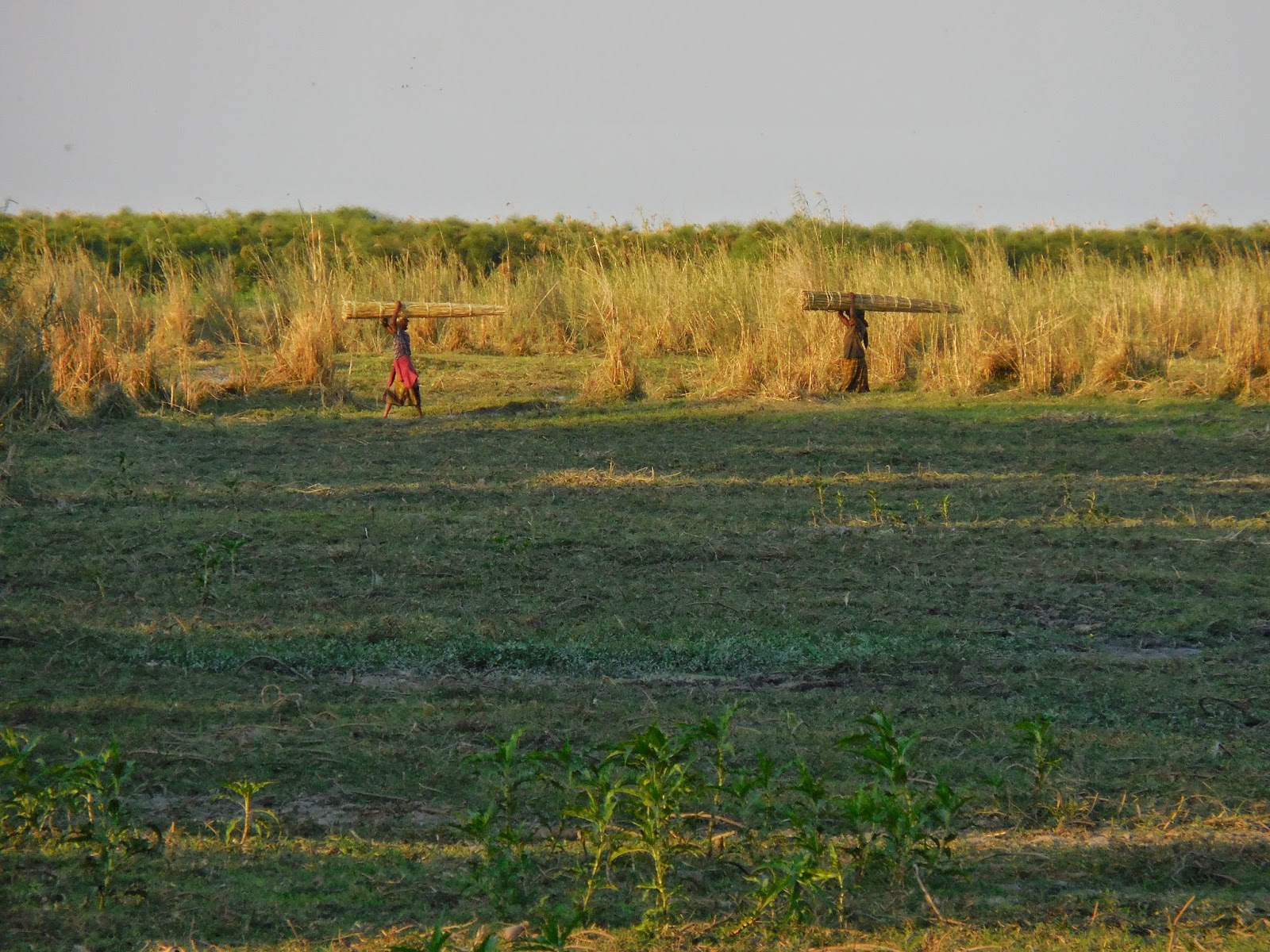
 People in this area also harvest reeds from the delta to use for house construction, roofing, basket weaving, and other uses as well. This time of year is best to harvest because the water level is low. Women go out in pairs at the beginning of the day to harvest reeds. By going in pairs, they are able to talk to each other, and the sound of their voices wards off any hippos or other dangerous animals. I love to sit and watch them come home at the end of the day with large bundles of reeds balanced on the tops of their heads.
Reed collectors coming home after a day on the flood plains
 

Keep driving until you see a sign for Shakawe. If you hit Namibia you've gone too far....


Getting from Serowe to Shakawe was no easy feat. In fact, it took three days, a good dose of frustration, and a whole lot of anticipatory energy. We were supposed to leave early Thursday morning, but our driver decided to spend Wednesday night in Maun, a village very far from where we were supposed to meet. Needless to say, we didn’t end up departing until Friday. After loading our things into the flatbed of a truck, two other PC volunteers and myself piled into the cramped cab of a car bound north.


The drive was actually nice—we got to see a lot of the country that we had yet to see. We passed by a few diamond mining towns, a big salt pan, and a very flat and grassy part of the country with very little vegetation. The first time we saw elephants on the drive, I asked our driver (Mbango) if we were passing through a game reserve of some sort. He responded with, “No, they are just there.” Upon seeing our excitement over the eles, he veered off the tar road and into the bush to get us a closer view. Luckily we managed not to lose any luggage in the expedition through the thorn trees! When we were driving through the flat grassy part of the country I mentioned earlier, we saw three more elephants. We pulled over to the side of the road and watched as they advanced towards us and passed behind the car. No matter how many wild elephants I will see in my life, I could watch the movements of this animal endlessly.


passing behind the car with all our things packed tightly in


We finally made it to Maun, a big village on the apex of the delta. It was about 2:30 by this point, and we stopped for some food at a grocery store. The driver had gotten a call from his supervisor telling him to stop by the Toyota dealer in Maun to see if the car needed a tune-up. In fact, it did. It needed “major service.” They said they wouldn’t be done with it until 4:30 or 5:00 that evening. Suddenly all of the progress and elephant-happy hours we had spent in the car seemed all for naught. I clearly wasn’t going to make it to my village today. I couldn’t help but feel my heart sink. Was I ever going to get there? Maybe I was being a little melodramatic, but to be honest, I had never felt this kind of frustration before: the complete inability to get somewhere that you wanted to be so badly. In America, you can find a way….a friend will drive you, or maybe the Metro is going that direction, or you could even rent a car. But with my couple big bags of pots and dishes and my belongings for the next two years, I was stuck sitting in the car dealership for several hours. We finally got back on the road around 6:15.


As the sun set and night began to fall, it was very clear why driving at night is a big no-no for Peace Corps volunteers. There were donkeys and cows that seemed to come out of nowhere from the bush. Not to mention the pot holes and parts of the road that narrowed to less than the width of a one lane road. At one point, our driver had to stop the car and take a damp piece of paper to wipe the bugs off the windshield because it was impossible to see out, and the wipers only smeared the buggy mess. The air was so thick with the insects that while we were driving, if you closed your eyes, it sounded like it could have been drizzling. The other two PCVs and I could only look at each other and start laughing, wondering what we had gotten ourselves into by requesting to be in a part of the country where we could conduct malaria projects (we later learned that they were not mosquitoes, just a cloud of some other flying insect…a little bit of a relief?).


As we were driving, we passed the first sign that had “Shakawe” on it. I honestly don’t know what came over me, but after a few longs days of anticipation and traveling and frustration, I started crying. A lot. Good thing that after spending all day in close quarters with a group of people, any embarrassment I would have otherwise felt was long gone. I was overcome with the realization that after over two years of fighting Peace Corps Headquarters to become a PCV, I was almost to my new home. Seeing that sign and watching the kilometers left to go decrease with each passing sign sent through me a totally unexpected wave of emotion. I am doing this. And I am almost there.


After a brief stop in Gunmare, we continued on to Etsha 6, where the closest of the three of us would be living. We were dropped off and it was all we could do not to collapse upon opening her front door. And after the initial excitement of seeing her new little house, we did just that.


Mosquito nets are a must up here (whether you can hang it or not). Can you spot the tired PCV?


The next morning was both wonderful and a test of my patience. The three of us made breakfast consisting of scrambled eggs with cheese and bread with Nutella. It may not sound like much, but it was a feast and a perfect inaugural meal for the house. I knew transportation was coming to pick me up, but I was unsure when exactly it would be, so I took a chair outside and practiced being patient…again. Finally finally finally, I spotted a vehicle turn the corner with the words “SHAKAWE MOBILE CLINIC” proudly displayed across the side. I promise I am not being overly dramatic when I say that in that moment, I started to get extremely light headed and felt like I was going to pass out. I took several deep breaths, put my head between my knees, and collected myself. It was finally time to go home.


I was dropped off at my house in Shakawe, about 11km from the Namibian border, and upon entering my house I quickly realized there was no furniture other than a mattress. I had no stove, no refrigerator, no gas, nada, and no guarantee of when they would come. I’m not going to lie, I sat on the floor in the middle of my empty living room for about 15 minutes, unsure of what to do next. It was the first time I had felt completely alone in almost three months. I simultaneously loved and (unexpectedly) hated it. But I finally got my wits about me and made a plan. I remember telling myself—“I am a Girl Scout and a Peace Corps Volunteer. I can do this.” I started gathering fire wood from my yard to use later to boil some water. In the process I met the woman who lives on the same compound as me and mentioned my situation to her. About 20 minutes later, she showed up to my door with a heaping plate of food. I almost cried from her kindness. With a full belly,  I gathered my backpack, wallet, and some water and decided to set out to find the grocery store to buy some non-refrigerated food to tide me over until my fridge decided to show up…not exactly sure where the store was or how far away. At about that moment, my supervisor pulled up to my house with an electric hot plate to hold me over until the gas situation was worked out. I felt like I could breathe out a little bit.

My refrigerator arrived the next day. As I write this a week later, I finally have a propane cylinder in my house, but my stove and the rest of my furniture is still sitting in a trailer at the clinic. For now the floor is my table, my chair, my couch, and my stove top.  Stay tuned, folks.


Monday, 13 October 2014

Pictures from site annoncement!

Anxiously waiting

Reading my proverb and site!

Pointing to my new home


A Botswana Wedding (or two...)


It has become apparent pretty quickly that we have entered wedding season here in Botswana. And they do things a little differently than in the States. First of all, there are two weddings for each couple—one in the kgotla (ward) from which the groom is from, and a whole nother ceremony in the kgotla where the bride is from. Sometimes the bride and groom are from entirely different parts of the country, so they will have two ceremonies on two different weekends in different villages. Secondly, anyone can come to a wedding, no invitation necessary. Maybe the bride is a relative of yours. Maybe you hear about it from a friend of a friend. Maybe you just live in the area, hear music playing and want to grab some free food. Apparently everyone is invited. The immediate family sits under a big tent, while everyone else sits around the yard wherever to eat. It’s very much organized chaos.


I’ve been to two weddings now, and at each one the menu seems to be pretty standard. All of the food is cooked in huge cast iron pots over open fires. There are usually lots of women relatives who are behind the scenes mixing huge buckets of food. Even with so many guests, there always manage to be leftovers! Here’s what’s generally served:

-          bogobe jwa legapu (sorghum porridge made with sour milk and with melon added into it)
-          rice (different varieties)
-          Samp (made from kernels of corn that have had the outer shell removed…this is one of my favorite things to eat here)
-          Seswa (basically pulverized meat from all parts of the animal that are combined)
-          Legata (a mixture of beans, samp, and, if you’re lucky, some peanuts thrown in)
-          beet root (seems to be sort of pickled a lot of the time)
-          Setswana-style coleslaw (Batswana love cabbage and what they call “tangy mayonnaise”)
-          Lephutshe (butternut squash cooked and mashed)
-          potato salad (more tangy mayonnaise…and peas too?)
-          Chicken
-          and a couple other variations of meat


I learned that at the last wedding I went to, there were five cows that had been slaughtered for the event. So you can imagine that having enough food to feed the entire village is a ton of food. Interestingly, some portions of the cow go to certain family members. For example, the bride’s uncle (called the “malome”—the mother’s brother) negotiates a lot of things for the wedding, and he gets a whole shoulder/leg I believe. One aspect of the whole marriage he arranges is the lebola, or essentially the dowry. The higher status the bride has, the more cows the groom’s family must pay for him to marry her. Even with more modern families in Botswana, this is still something that seems to be widely practiced. In Setswana, it is very apparent how important family is just based on the huge variety of words used to describe family members, other than malome, there are specific words for older siblings, younger siblings, siblings of the opposite sex, cousins, and on and on. (there also a million words for the color brown, while the colors blue and green are called the same thing….can you tell it’s a drought-ridden country?


The entertainment is great, too. There are always a group of traditional dancers that are brought in to entertain the guests. They wear animal skins and have some sort of seeds tied around their ankles that rattle and make noise when they step. It’s really fun to watch—definitely one of my favorite parts. The bridal party also does a choreographed dance before the food is served. Apparently it’s a big deal, as the bridal party meets every weekend for months leading up to the event to practice for a few hours. It’s definitely impressive!


After the entertainment and everyone has eaten, all of the married women sit with the bride, while all of the married men sit with the groom. I don’t know what exactly is said in the groom’s circle, but I was able to watch the bride’s. A friend and I were sitting outside of the circle, and a few basadi bogolo (old women) motioned for us to come and sit inside it with them. As you can see below, all of the women had their head and shoulders covered, which we did not. A woman ran over making a high pitched shrill noise and put shawls around both of us. Our heads were still uncovered, but that seemed to be okay. The photographer, a friend of the bride’s, wasn’t even allowed in because she was wearing pants…apparently a big no-no. One at a time, different women got up and stood in front of the bride—there was singing, shouting, kneeling, dancing, all sorts of weird things going on. We learned later that they were giving her advice on how to stay grounded and not try to change her husband, etc. Basically advice to her on marriage. They also gave her a shawl and a head scarf to tie around her head, thus signifying that she is now a married woman. There were some very old women there who could hardly stand up, and they were getting down on their knees to offer her advice. It was really neat to witness and I’m so thankful that they let us sit with them and be included. The women then are all served a jello/custard dessert (wedding cake doesn’t seem to be a thing here), while the men get to feast on what is considered the best part of the cow—the back and the stomach. Only men are allowed to eat this meat. I also learned that it is supposed to signify the joining of two families coming from different places (back/stomach) but combining to make something special (yummy?).

The basadi bogolo giving advice to the bride.