Thursday, 17 September 2015

Mediations on a halfway point: A photographic update....Daily Life

Here are some images from my day to day life in Shakawe. The captions should shed some light on what is taking place in each one.
 
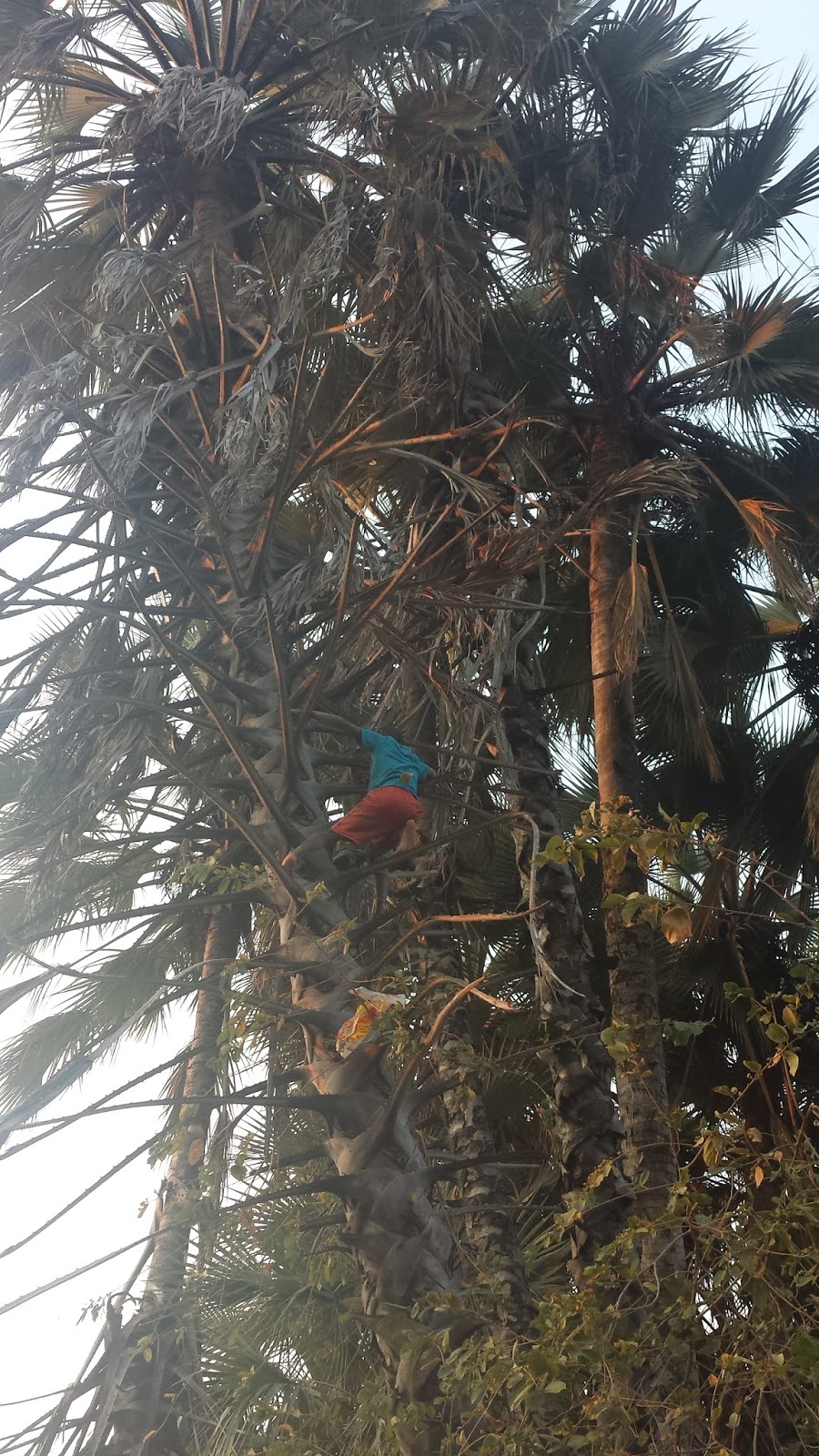
There are palm trees in my backyard with palm apples at the very very top. Kids come through my yard at all hours of the day throwing rocks to get them down. But then this boy started to climb...

This woman is selling "tswii," or roots of lilies in the river. They are yummy, especially when mixed with seswaa (slow cooked, pounded and salted meat)

An average household in Shakawe.

I built a tire swing in my yard for the kids to play on

Probably giving some kind of science lesson :)

The dogs that follow me herding goats on my way to the clinic....this happens several times a week. People think they are mine. It's embarrassing.

Learning how to skin s goat with another PCV.


Petrol in my village goes out for days. This is one of the instances where it came back. Word travels fast, and soon there was a long line.


My neighbor dressing up in her mom's shoes

Playing with a kite with my neighbor on a breezy Sunday

One of my counterparts, Mphande, pictured in the middle. These are mothers and caregivers of children under 5 who come once a month to have their child weighed to check for malnutrition and growth failure. They also receive ration from the government once a month. We are often out of stock, but this is one of the days where we had lots of food to distribute! Caregivers came from far reaches of the village to get their share.

My cat, Tsala, of course.

A cow chewed holes in my clothes that were drying on the line.


A friend of mine and her twins. She was one of the first people I met in Shakawe. I love this portrait for her.

Kids drew a map of Shakawe with chalk on my doorstep

Young school kids using chalk as "make-up." I told them they were all beautiful.

Applying their make-up, boys and girls.

Someone's ride parked outside the clinic.

So my house sometimes turns into a movie theater.
Also a soccer field. Also an art gallery.

A photo walking through Shakawe


Meditations on a halfway point: A photographic update...Workshops, etc.

 
Workshops, etc.
 
MALARIA
This week another volunteer and I got the opportunity to attend the national malaria conference along with a PC staff member. The three of us presented on the efforts of PCVs in Botswana to contribute to the elimination of malaria. Botswana is one of 8 countries in southern Africa working to eliminate the disease. One of the tools widely used is indoor residual spraying (IRS), where teams spray the interior walls of homes with insecticide to reduce the mosquito population and interrupt the malaria transmission cycle. Tiphaine (the other volunteer pictured) and myself are working to use GPS units to mark which houses are sprayed and not sprayed in our villages. You can then look at the spatial distribution of these points and use that data to do targeted follow up in certain parts of the village that have low coverage. We also want to GPS the locations of malaria cases in our communities to compare the hot spots with the IRS coverage to see if there is a correlation. Exciting stuff!


Explaining the mapping program, OpenStreetMap, which we are using for these mapping initiatives.


GENDER
I hosted a gender-based violence workshop using a tool called "In Her Shoes" for about 30 police officers in my village. After rescheduling twice and two local counterparts bailing on me, I decided to do the workshop by myself. I would have preferred to co-facilitate with a counterpart, but with the way things went I was alone. I was very nervous, but quickly found my stride and facilitated some good conversations following the activity.


(MORE) MALARIA 
I also helped train the malaria community mobilizers for my village and the handful of villages in our catchment area. Leading up to that, I developed the training curriculum for the district health team staff who trained the mobilizers in the rest of the district where I couldn't attend the training sessions. It felt like a good way to help capacity build and contribute my own knowledge to the training program while still allowing the district staff to take the lead, as it should be. 
 

The first day of training was with community leaders, meaning the chiefs of the local villages. I was surprised at their lack of knowledge coming into the training.

One of the staff members from the district health office training the chiefs.

Community Health Educators demonstrating to the Community Mobilizers how to hang a bed net.


I developed this simple training tool to help test the volunteers' knowledge about how to assess a compound while using the field reporting tools they will be employing on a daily basis.


 WORLD BREASTFEEDING WEEK
 
This was something I didn't personally help plan, but I participated in the event at my clinic. Mothers were trained on correct hygiene practices as well proper positioning and attachment of infants. We even gave out prizes for those who were doing it best.
 
Two of my counterparts, both health educators, teaching the mothers together. There were even a few fathers present!

And because pregnant mothers are at a heightened risk for malaria, we also did a bed net demonstration.

Meditations on a halfway point: A photographic update...Youth Projects


Youth Projects...
 
A fellow volunteer and myself have taken two groups of students on two school trips, one to the nearby World Heritage Site "Tsodilo Hills," and the other across the river to Sekondomboro for a camping trip. 


The kids at Tsodilo Hills.


Transport in the back of a flatbed truck, how else?

 
From the camping trip:
They were able to ride in traditional dug-out canoes, known as "mokoros"


The other PCV was teaching how to skip rocks while waiting for the ferry to go home.


I also teach an art class with Standard 1 (first grade) students once a week. Here are some photos from when we made paper hats and did potato printing.


I meet with the Environmental and Health Education Club at the primary school once a week as well. We do different activities to teach about the environment, which is especially important for these students living on the banks of the Okavango River.
 

The club (yep, that's a Chinese student who also lives in the village. A lot of small shops in this country and others surrounding it are actually owned by Chinese families.)

Playing a game like "Marco Polo" where the blindfolded child yells "bat" and the others run around the circle yelling "moth" in response. The game teaches the kids about bats and how they use echolocation to find food. They had a blast!
 
We used a program called Grass Roots Soccer to teach kids about HIV/AIDS and also malaria. In this game, the blanket represents the bed net, while the ball is the mosquito. The kids had to fit under the "net" and avoid the mosquito. If they were "bitten," they had to go and high five the designated doctor at the local clinic to get treated.

I have been working to start Youth Friendly Services at my clinic to provide psychosocial, sexual and reproductive, and general health care specialized for children and teens. It's a project in progress, but we are working hard.


Friday, 11 September 2015

Rude or Not Rude...?


This post is to test your (probably nonexistent) knowledge about what is rude or acceptable or even polite in Batswana culture. Some of these things I learned within my first few weeks here, and others are much more subtle. But all of them are important for integration here.

Q: Failing to say "thank you" when someone gives you something.
A: NOT RUDE. Batswana have their own ways of saying thank you using body language. For example, receiving a gift with two hands, bending the knees slightly, or placing the left hand on the elbow with the right hand extended palm up to receive the item. I have heard people utter the words "thank you" very very few times since coming here.

Q: Writing a brief letter asking for materials from a local government office, printing, and sending the letter.
A: RUDE. Very rude. What I mean is, you need to have the letter be in the proper format, marked with an official stamp of your organization, first sent to your superior/their superior/etc., and then to send multiple copies to all involved stakeholders, including printing at least two copies for yourself. And then you've done it correctly. Protocol is everything here, and people get very offended if you skip a step or put the "From" address below the "To" address in the header. Believe it or not, smaller things have angered people in government offices here. It's ridiculous. It's how things work.

Q: Packing snacks and eating them quietly by yourself during a break at the clinic.
A: RUDE. You always always always offer whatever you are eating to other people. No matter how hungry you are, no matter how special that box of trail mix your mom sent you in that last care package is. If you don't want to share, don't take it out. This is a culture where eating from the same plate (with your hands, of course), is how you mark friendship. Everything is communal. So get used to it.

Q: Asking someone to give you an article of clothes that they are wearing.
A: NOT RUDE. In fact, I have found that this is a form of flattery in this country. When people used to ask me to give them my shirt, shoes, etc., I would cheekily respond by saying that then I would be naked, and we wouldn't want that. But now I realize that, in fact, it's a way for someone to compliment you. I think they secretly think that all white people will freely give their clothes away though, which is the underlying reason why they are asking. Like, "maybe this time she will give me her shoes....let me just ask."

Q:  Asking someone older than you how they are doing today.
A: RUDE.
In this culture, it is commonly accepted that if you are greeting an elder, they are the ones who should ask you how you are doing. To ask them before they ask you (and in some cases, to ask them at all), is considered rude. Like many cultures in this part of the world, elders are respected. Botswana is no different.

Q: Showing up at someone's wedding unannounced.
A: NOT RUDE. There's no such thing as a wedding invitation here...people usually set up a tent with tables and chairs for the close friends and family, but the surrounding area is fair game for anyone. Don't know the bride or groom? No problem. They cater enough for literally the whole village (except for dessert). If you run out of food, it's considered really bad and reflects negatively on the family. Also if you're just dropping by because you heard the music blasting from across town, wardrobe is no problem. The wedding party and family dress up, but for the "commoners" there's really no dress code.

Q:  Offering a friend money to cover the cost of a drink or food they bought you.
A: RUDE. So rude...what were you thinking? Coming from America, where split checks and Venmo rule the world, I arrived with the mindset that NOT at least offering to pay for such a thing is rude. Sure, maybe your friend in America will brush it off and say "No, no, this one's on me," but at least you offered. Common courtesy, right? Well here, if you so much as offer, people get offended. If you are friends with someone, you pay for things for them with the expectation that you will return the favor. That's how it works.

Q: Refusing food or drink that's offered to you.
A: RUDE. Well, maybe not rude, but it's at least strange. When you go to a person's house, they will always offer you something. Maybe just water, but often tea or whatever food is cooking at the time. In America, I was taught that it is most polite to just decline so as not to inconvenience the host. But here, people rarely turn away what is offered to them. Also going to someone's house to visit them and asking for something to eat or drink isn't considered rude either. In fact, it's common courtesy.

Thursday, 10 September 2015

Tiny Botswana Story #2

I was helping out at the children's clinic the other morning where the mothers bring their children under the age of five every month to be weighed to check for malnutrition. There was a child who was brought in for a post natal care visit following a home birth. He was three months of age, and hadn't gained any weight since the day he was born. If you know anything about tiny babies, it should be that they start packing on the pounds and growing/developing from the moment they enter this world. But this baby wasn't. The mother claimed that both this boy and her other child looked like lizards when they were young. To me, that's a direct consequence of a child being malnourished, but to her, it's a sign of something else. Likely that she or her children have been cursed.

The doctor (he is from DRC) came to see the child. He realized part of the problem was that the mother wasn't producing enough milk because of her diet, so he gave her money out of his own pocket so she could go and buy milk for herself.